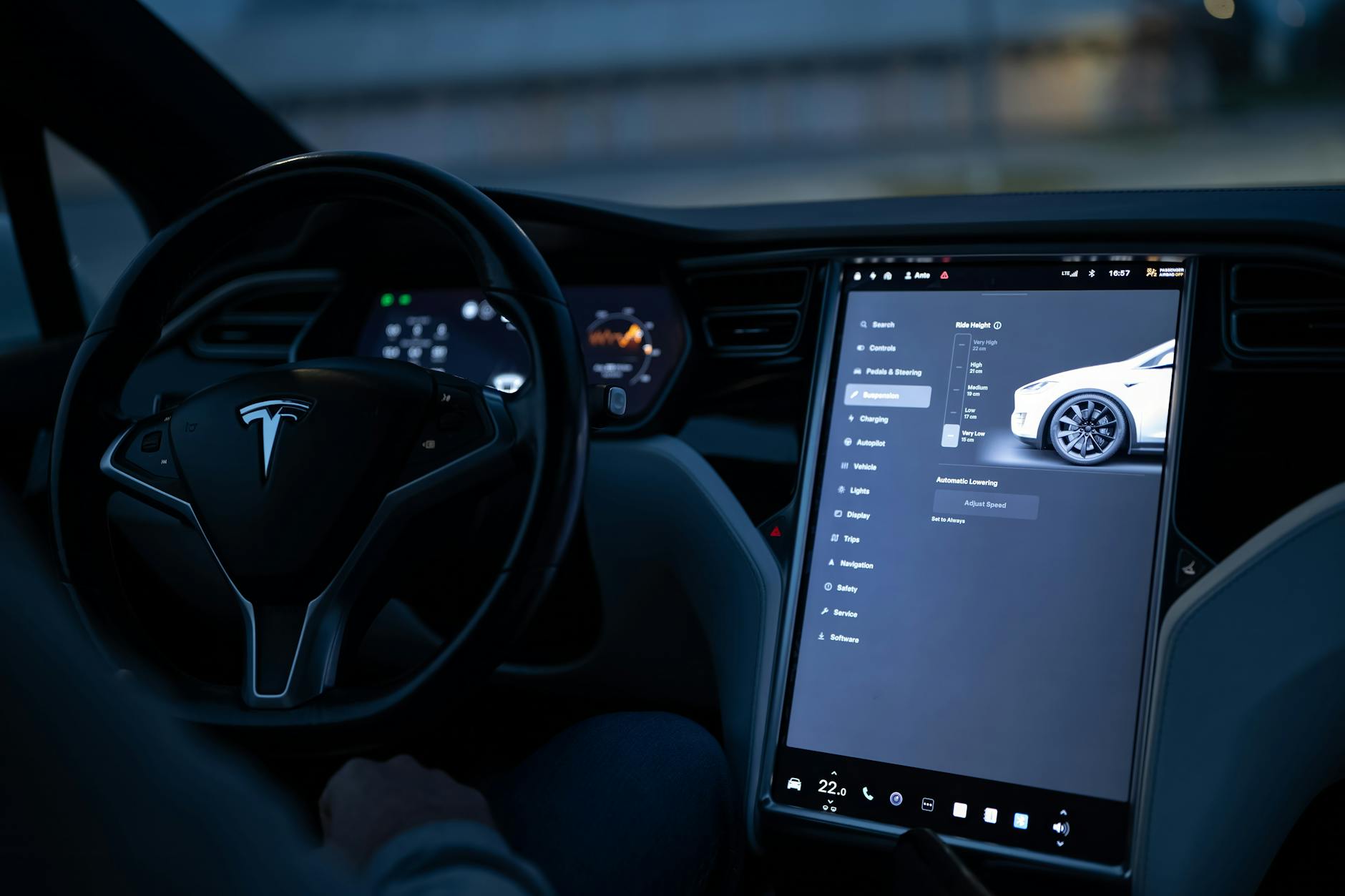
How Do Self-Driving Cars Work? Your Ultimate Guide
how do self-driving cars work

How Do Self-Driving Cars Work? Your Ultimate Guide

Explore the intricate technologies and groundbreaking innovations propelling the world towards a future of autonomous transportation.

Dive Into Autonomy

Key Takeaways

  • ✓ Self-driving cars rely on a fusion of sensors, cameras, radar, and Lidar for environmental perception.
  • ✓ Artificial Intelligence (AI) and machine learning are crucial for decision-making and prediction.
  • ✓ There are six levels of driving automation, from Level 0 (no automation) to Level 5 (full automation).
  • ✓ High-definition mapping and V2X communication are vital for navigation and safety.
  • ✓ Robust cybersecurity measures are essential to protect autonomous vehicle systems from threats.

How It Works

1
Perception: Sensing the World

Vehicles use an array of sensors—cameras, radar, lidar, and ultrasonics—to gather real-time data about their surroundings. This creates a comprehensive 360-degree view of the road, traffic, pedestrians, and obstacles.

2
Localization: Knowing Where You Are

Using GPS, inertial measurement units (IMUs), and high-definition maps, the car precisely determines its location on the road. This pinpoint accuracy is critical for safe navigation and adherence to lane markings.

3
Prediction: Anticipating Movement

Advanced AI algorithms analyze perceived data to predict the movements of other vehicles, pedestrians, and cyclists. This allows the car to anticipate potential hazards and plan its actions accordingly.

4
Planning & Control: Making Decisions

Based on perception, localization, and prediction, the vehicle's central computer plans a safe and efficient path. It then executes these plans by controlling the steering, acceleration, and braking systems.

The Sensory Organs: How Autonomous Vehicles See the World
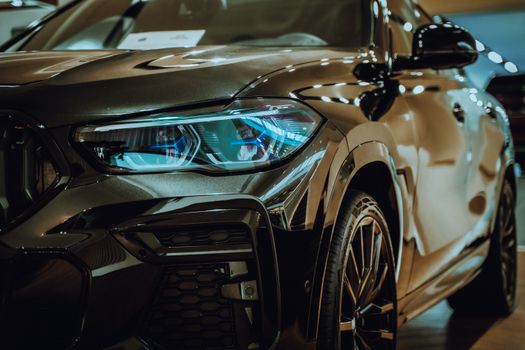
Close-up of a sleek, luxurious black car with stunning reflections in an indoor parking lot. Photo: Boris Ivas / Pexels
At the heart of understanding how do self-driving cars work is their ability to perceive their environment with unparalleled accuracy and detail. Unlike human drivers who rely primarily on vision and sound, autonomous vehicles employ a sophisticated suite of sensors, each playing a crucial role in constructing a real-time, 360-degree digital model of the world around them. This perception system is the foundation upon which all subsequent autonomous functions are built. Without it, the car would be blind, deaf, and unable to react to its surroundings. Cameras are perhaps the most intuitive of these sensors, acting as the 'eyes' of the car. They capture visual data, much like a human eye, identifying traffic lights, lane markings, road signs, pedestrians, and other vehicles. Advanced computer vision algorithms then process these images, recognizing objects and classifying them. For instance, a camera might detect a red octagon and classify it as a 'stop sign,' or identify a moving shape as a 'pedestrian.' The challenge with cameras lies in their susceptibility to varying light conditions, such as bright sunlight, shadows, or heavy rain, which can obscure details and reduce their effectiveness. Radar (Radio Detection and Ranging) systems overcome some of these visual limitations. Radar sensors emit radio waves and measure the time it takes for these waves to bounce back after hitting an object. This allows them to determine the distance, speed, and direction of objects, even in adverse weather conditions like fog, heavy rain, or snow. Radar is particularly effective at detecting metallic objects, making it excellent for tracking other vehicles. However, radar typically has lower resolution compared to cameras or Lidar, meaning it's less adept at identifying the shape or specific type of an object. Lidar (Light Detection and Ranging) systems are often considered the 'gold standard' for precise environmental mapping. Lidar units emit millions of laser pulses per second and measure the time it takes for each pulse to return. This creates a highly detailed 3D 'point cloud' map of the surroundings, offering exceptional accuracy in measuring distances and object shapes. This 3D data is invaluable for understanding the precise geometry of the road, detecting subtle obstacles, and differentiating between various objects. The drawback of Lidar has traditionally been its cost and its performance in certain weather conditions, though these aspects are continually improving. Emerging Lidar technologies are making these systems more compact and affordable. Finally, ultrasonic sensors, similar to those used in parking assist systems, are employed for short-range detection. They emit sound waves and measure the reflections to detect nearby objects, making them ideal for low-speed maneuvers like parking or navigating tight spaces. Each of these sensor types has its strengths and weaknesses. The true power of an autonomous vehicle's perception system lies in the fusion of data from all these diverse sensors. By combining and cross-referencing the input from cameras, radar, Lidar, and ultrasonics, the vehicle's central computer can create a robust, redundant, and highly accurate understanding of its environment, far surpassing the capabilities of any single sensor. This multi-modal approach ensures that even if one sensor's performance is compromised, others can compensate, maintaining a reliable perception of the world.

The Brains Behind the Wheel: AI, Machine Learning, and Decision-Making
A small robotic figure with a smiling face on a car dashboard, lit by blurred speedometer lights at night. Photo: Erik Mclean / Pexels
Once the plethora of sensory data is collected, the next crucial step in understanding how do self-driving cars work involves processing this raw information and transforming it into actionable decisions. This is where the sophisticated 'brains' of the autonomous vehicle come into play, powered by advanced Artificial Intelligence (AI) and machine learning algorithms. These computational systems are responsible for interpreting the environment, predicting future events, planning the vehicle's trajectory, and ultimately controlling its physical actions. At the core of this intelligence are deep learning neural networks, a subset of machine learning that excels at pattern recognition and complex decision-making. These networks are trained on vast datasets of real-world driving scenarios, including millions of miles of actual road data and simulated environments. Through this extensive training, the AI learns to identify objects, understand their behavior, and predict their likely next moves. For example, it learns that a pedestrian at a crosswalk is likely to step into the road, or that a car signaling a turn will likely change lanes. This predictive capability is paramount for safety. Unlike reactive human drivers, who might only react once a hazard is present, autonomous vehicles aim to anticipate potential risks seconds or even minutes in advance. The AI models consider numerous variables simultaneously: the speed and trajectory of other vehicles, the presence of cyclists, traffic light states, road conditions, speed limits, and even the intentions of other drivers (inferred from their behavior). This allows the system to continuously update its understanding of the dynamic environment and make proactive decisions. Following perception and prediction, the AI's planning module takes over. This module is responsible for generating a safe, comfortable, and efficient path for the vehicle. It considers various factors such as avoiding obstacles, maintaining safe following distances, adhering to traffic laws, optimizing for fuel efficiency, and ensuring a smooth ride for occupants. The planning module operates on multiple levels: a global planner might determine the overall route from origin to destination, while local planners continuously adjust the vehicle's immediate path, speed, and lane positioning in response to real-time events. Finally, the control module translates these high-level plans into precise physical commands for the vehicle's actuators. This involves sending signals to the steering system to turn the wheels, the accelerator to adjust speed, and the braking system to slow down or stop. These commands must be executed with extreme precision and responsiveness, ensuring that the car reacts appropriately to its environment. The entire process—from sensing to perception, prediction, planning, and control—occurs in milliseconds, a continuous loop that allows the autonomous vehicle to navigate complex driving situations with remarkable dexterity. The iterative nature of machine learning also means that these systems are constantly learning and improving, theoretically becoming safer and more capable over time as they encounter new scenarios and data.

Beyond the Basics: High-Definition Maps and Vehicle-to-Everything (V2X) Communication
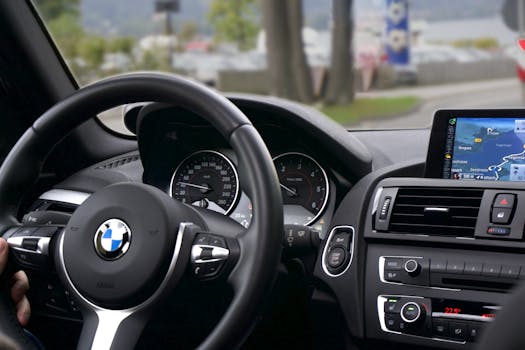
Elegant BMW car interior showcasing navigation screen, speedometer, and steering wheel. Photo: Ingo Joseph / Pexels
While sensors and AI form the core of how do self-driving cars work, two additional components significantly enhance their capabilities: high-definition (HD) maps and Vehicle-to-Everything (V2X) communication. These technologies provide crucial contextual information and enable interaction beyond the vehicle's immediate sensory range, pushing the boundaries of autonomous driving beyond what a human driver or even sensor-alone system could achieve. High-definition maps are not your standard GPS navigation maps. They are incredibly detailed, centimeter-level accurate representations of the road network, far exceeding the precision of consumer-grade maps. These maps contain static information such as lane markings, road signs, traffic light locations, curb heights, pedestrian crossings, and even the precise geometry of turns and intersections. They also include dynamic information, constantly updated, about construction zones, temporary lane closures, or other transient road conditions. HD maps serve several vital functions for autonomous vehicles: Firstly, they provide a robust prior knowledge base, allowing the vehicle to anticipate what's ahead even before its sensors detect it. This is especially useful in situations where sensor visibility might be limited, such as around blind corners or over hills. Secondly, HD maps aid in localization. By comparing real-time sensor data (like Lidar point clouds) with the map's detailed features, the vehicle can pinpoint its exact position on the road with remarkable accuracy, far surpassing GPS alone. This precision is critical for staying within lanes and navigating complex intersections. Thirdly, they help in path planning, providing the AI with a rich understanding of the optimal route and potential maneuvers, significantly reducing the computational load on the real-time perception system. V2X communication, on the other hand, is about connecting the vehicle to its broader environment. It encompasses several sub-categories: * **V2V (Vehicle-to-Vehicle):** Allows cars to wirelessly exchange information with each other, such as speed, heading, braking status, and even potential hazards. Imagine a car several vehicles ahead braking suddenly; V2V could alert your autonomous vehicle instantly, allowing it to react faster than if it had to wait for its own sensors to detect the brake lights or deceleration. This significantly improves collision avoidance and traffic flow. * **V2I (Vehicle-to-Infrastructure):** Enables communication between the vehicle and road infrastructure, such as traffic lights, road sensors, and smart signage. This could mean receiving real-time information about traffic light timings, allowing the car to adjust its speed to hit a green light, or getting alerts about upcoming construction zones or adverse road conditions. Smart city initiatives are heavily investing in V2I infrastructure. * **V2P (Vehicle-to-Pedestrian):** While still evolving, this involves communication with pedestrians and cyclists, potentially through their smartphones or wearable devices. This could warn pedestrians of an approaching autonomous vehicle or alert the vehicle to the presence of a pedestrian obscured from its sensors. Together, HD maps and V2X communication create a more informed, anticipatory, and interconnected autonomous driving system. They augment the vehicle's on-board intelligence, providing a richer context and enabling collaborative driving scenarios that promise to enhance safety, efficiency, and overall driving experience. These technologies are foundational to achieving higher levels of driving automation and realizing the full potential of self-driving cars.

The Levels of Autonomy and Future Challenges
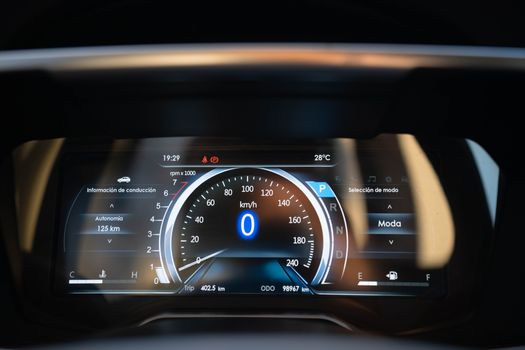
Close-up of a digital car dashboard in Buenos Aires, displaying a speedometer reading of zero km/h. Photo: Martin.que / Pexels
Understanding how do self-driving cars work also requires grasping the concept of different levels of driving automation. The Society of Automotive Engineers (SAE) has defined six levels, from Level 0 (no automation) to Level 5 (full automation), providing a standardized framework for classifying autonomous vehicle capabilities. This classification helps in understanding the current state of technology and the roadmap for future development. * **Level 0 (No Automation):** The human driver performs all driving tasks. This includes most cars on the road today without any advanced driver-assistance systems. * **Level 1 (Driver Assistance):** The vehicle has either steering *or* acceleration/deceleration support. Examples include adaptive cruise control or lane keeping assist, where the driver is still fully responsible. * **Level 2 (Partial Automation):** The vehicle can control both steering *and* acceleration/deceleration simultaneously, but the human driver must remain engaged and monitor the driving environment at all times, ready to take over. Tesla's Autopilot and GM's Super Cruise are examples of Level 2 systems. * **Level 3 (Conditional Automation):** The vehicle can perform all driving tasks under specific conditions (e.g., highway driving), and the driver is not required to monitor the environment. However, the driver must be prepared to intervene when prompted by the system. This is a significant leap as it introduces the concept of 'eyes off' driving for periods, but the handover process remains a complex challenge. * **Level 4 (High Automation):** The vehicle can perform all driving tasks and monitor the driving environment under specific conditions (e.g., within a geofenced area or specific weather conditions). If the system encounters a situation it cannot handle, it will safely bring the vehicle to a minimal risk condition (e.g., pull over). No human intervention is required within its operational design domain (ODD). * **Level 5 (Full Automation):** The vehicle can perform all driving tasks under all conditions, equivalent to a human driver. There is no need for human intervention, and the vehicle may not even have a steering wheel or pedals. This represents the ultimate goal of self-driving technology. Currently, most commercially available systems are at Level 2, with some manufacturers cautiously testing Level 3 in limited scenarios. Achieving Level 4 and, especially, Level 5 presents formidable challenges. These include navigating unpredictable urban environments, handling extreme weather, dealing with complex social interactions on the road, and ensuring absolute cybersecurity against malicious attacks. The 'edge cases' – rare, unusual, or ambiguous situations – are particularly difficult for AI systems to master. Furthermore, regulatory frameworks, legal liability, and public acceptance are critical hurdles that need to be addressed before widespread adoption of higher levels of autonomy can occur. The future of self-driving cars is not just about technological advancement, but also about societal readiness and robust policy development.

Comparison

FeatureHuman DriverLevel 2 AutonomyLevel 5 AutonomyV2X Communication
PerceptionEyes, EarsSensors, Cameras, AISensors, Cameras, AI, HD MapsShared Sensor Data
Decision MakingIntuition, ExperienceAI (Driver Monitored)AI (Fully Autonomous)Collaborative AI
Reaction TimeVariableFast (Driver Override)Millisecond PrecisionPre-emptive Alerts
Error RateHigh (Fatigue, Distraction)Low (Driver Intervention)Extremely Low (Theoretical)Reduced (Shared Awareness)
AdaptabilityHighLimited (Specific Scenarios)High (All Scenarios)Enhanced (Contextual Data)
ResponsibilityN/A

What Readers Say

"Understanding how do self-driving cars work has completely changed my perspective. The article broke down the sensor fusion and AI in such an accessible way, I feel much more confident about the technology now."

Sarah J. · Austin, TX

"I've always been curious about autonomous vehicles, and this guide truly delivered. The explanation of the different levels of automation was particularly insightful and clarified a lot of misconceptions I had."

Michael K. · San Jose, CA

"As an engineer, I appreciate the depth of technical detail without being overly jargon-heavy. This article on how do self-driving cars work provided excellent clarity on the complex interplay of hardware and software, a truly comprehensive read."

Emily R. · Boston, MA

"While the article was incredibly thorough, I would have loved even more examples of specific challenges in real-world driving. Nonetheless, it’s a fantastic resource for anyone wanting to understand the foundational tech."

David L. · Seattle, WA

"The section on V2X communication was eye-opening! I hadn't realized how interconnected the future of transportation could be. This article provides a great overview of how do self-driving cars work, from sensing to decision-making."

Jessica M. · Phoenix, AZ

Frequently Asked Questions

What are the core components that make self-driving cars work?

Self-driving cars primarily rely on a sophisticated combination of sensors (cameras, radar, Lidar, ultrasonics) for perceiving the environment, advanced Artificial Intelligence (AI) algorithms for processing data and making decisions, high-definition maps for precise localization, and powerful onboard computers to integrate all this information and control vehicle movements.

Are self-driving cars safe to use right now?

The safety of self-driving cars depends on their level of autonomy. Most commercially available systems are Level 2 (partial automation), requiring active human supervision. Higher levels (Level 3-5) are in testing or limited deployment, demonstrating promising safety records in controlled environments, but full autonomy in all conditions still faces significant challenges and ongoing development.

How do self-driving cars navigate in bad weather conditions?

Navigating bad weather is a major challenge. Self-driving cars use a combination of redundant sensors; for example, radar and Lidar can penetrate fog or heavy rain better than cameras. Developers are also working on specialized algorithms and heating elements for sensors to improve performance in snow, ice, and other adverse conditions, often relying on HD maps for additional context.

What is the cost implication of self-driving car technology?

Currently, vehicles with advanced self-driving features (Level 2+) often come at a premium due to the expensive sensor suite, specialized hardware, and extensive R&D. As technology matures and scales, costs are expected to decrease, making autonomous features more accessible to a wider market, though full Level 5 vehicles are likely to remain high-end initially.

How do self-driving cars compare to human drivers in terms of reaction time?

Self-driving cars generally have significantly faster reaction times than human drivers. Their sensors and AI can process information and initiate responses in milliseconds, whereas human reaction times are typically much slower, especially in unexpected situations or when fatigued or distracted. However, human drivers excel at nuanced decision-making in ambiguous scenarios.

Who should consider investing in a vehicle with advanced self-driving features?

Individuals who frequently drive long distances, commute in heavy traffic, or value enhanced safety features and convenience might find value in vehicles with advanced Level 2 (driver assistance) systems. For those interested in the cutting edge of tech, keeping an eye on Level 3 deployments in their region could also be appealing, understanding the current limitations.

What are the biggest risks associated with self-driving cars?

Key risks include cybersecurity threats (hacking), software bugs leading to unpredictable behavior, the challenge of 'edge cases' (unusual scenarios the AI hasn't encountered), sensor limitations in extreme conditions, and the complex ethical dilemmas of autonomous decision-making in accident scenarios. Regulatory and legal frameworks are still evolving to address these risks.

What does the future hold for self-driving car technology?

The future promises increasingly capable and widespread autonomous vehicles, particularly in geofenced urban areas and long-haul trucking. We can expect significant advancements in AI, sensor fusion, and V2X communication, leading to safer roads, reduced traffic congestion, and new transportation services like robotaxis, ultimately transforming urban planning and personal mobility.

Now that you have a comprehensive understanding of how do self-driving cars work, from their intricate sensor systems to their intelligent AI brains, you're better equipped to navigate the exciting future of autonomous transportation. Stay informed, stay curious, and witness the ongoing revolution that is reshaping our roads and our lives.

Topics: how do self-driving cars workautonomous vehicles explainedself-driving car technologyAI in carsfuture of transportation
Leo List
Brampton weed
Adultwork EstrelaBet Vai de Bet R7 Bet Betão Galera Bet Rainbet Bet9ja Shop SportyBet BetKing Sisal Loto Foot Hollywoodbets YesPlay Odibets RushBet Jugabet BetWarrior BetCity MSport betPawa Fortebet