
Explain Blockchain Technology Simply: Your Ultimate Guide
blockchain technology explained

Explain Blockchain Technology Simply: Your Ultimate Guide

Abstract futuristic cyber landscape with digital matrix and glowing lights.Photo: Pachon in Motion / Pexels

Explain Blockchain Technology Simply: Your Ultimate Guide

Unlock the mysteries of blockchain with clear, concise explanations and real-world examples.

Start Learning Now

Key Takeaways

  • ✓ Blockchain is a decentralized, distributed digital ledger.
  • ✓ Data is stored in 'blocks' linked chronologically and secured with cryptography.
  • ✓ Once recorded, data on a blockchain is nearly impossible to alter.
  • ✓ It forms the foundational technology for cryptocurrencies like Bitcoin.

How It Works

1
A Transaction Occurs

Someone initiates a transaction, like sending cryptocurrency or recording data. This transaction is then broadcast to the network of computers.

2
Validation and Packaging into a Block

Network computers (nodes) validate the transaction's authenticity. Once validated, multiple transactions are grouped together to form a new 'block' of data.

3
Mining and Cryptographic Hashing

Miners compete to solve a complex mathematical puzzle (Proof of Work) to add the new block. The solution creates a unique cryptographic hash, linking it to the previous block.

4
Block Added to the Chain

Once a miner successfully solves the puzzle, the new block is added to the existing blockchain. This updated chain is then broadcast and verified by all other nodes, making it a permanent record.

Understanding the Core Concepts of Blockchain

Hand writing 'ETH' on a whiteboard, highlighting Ethereum concept.Photo: RDNE Stock project / Pexels
To truly explain blockchain technology simply, we must first break down its foundational elements. At its heart, blockchain is a distributed ledger technology (DLT). Imagine a traditional ledger, like a bank's record book, but instead of one central entity owning and maintaining it, thousands of computers across the globe each hold an identical copy. This decentralization is perhaps the most revolutionary aspect of blockchain. No single person or organization has control, which inherently builds trust and resilience into the system. When a transaction occurs, it's not just recorded by one bank; it's recorded by every participant in the network. This eliminates the need for intermediaries, reducing costs and potential points of failure. Each 'block' in the blockchain is essentially a bundle of validated transactions. Think of it like a page in that digital ledger. Once a page is filled with transactions, it's sealed, given a unique digital fingerprint (a cryptographic hash), and then linked to the previous page. This creates an immutable chain, hence the name 'blockchain.' The cryptographic hash is crucial; if even one character in a transaction within a block were altered, its hash would change, immediately invalidating it and breaking the chain. This makes tampering incredibly difficult, almost impossible, as every subsequent block would also need to be re-mined and re-validated across the entire network. This inherent security is a cornerstone of why blockchain is so revolutionary. Furthermore, blockchain operates on a consensus mechanism. This means that for any new block of transactions to be added to the chain, the majority of the network participants must agree on its validity. This prevents malicious actors from unilaterally adding fraudulent transactions. Different blockchains use various consensus mechanisms, with 'Proof of Work' (PoW) being the most famous, employed by Bitcoin. PoW involves competitive computational puzzles that miners solve to validate blocks, ensuring that adding new blocks requires significant effort, further deterring bad actors. This combination of decentralization, cryptographic security, and consensus mechanisms creates a system that is transparent, secure, and resistant to censorship. Understanding these core concepts is the first step in grasping how blockchain can transform various industries, from finance to supply chain management. For a deeper dive into how different cryptocurrencies leverage this technology, you can explore cryptocurrency basics.

How Blockchain Technology Actually Works: A Step-by-Step Breakdown
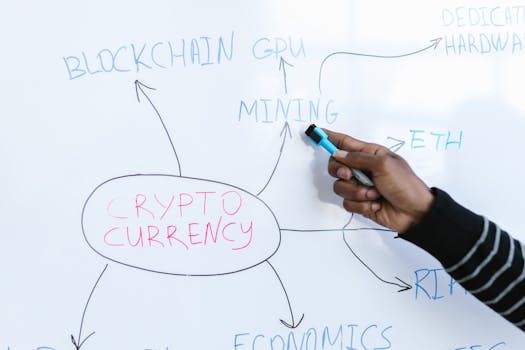
Close-up of a hand pointing at a flowchart diagram related to cryptocurrency on a whiteboard.Photo: RDNE Stock project / Pexels
Now that we’ve touched on the core concepts, let’s explain blockchain technology simply by walking through the process of how a transaction gets added to the chain. Imagine Sarah wants to send some digital currency to John. This isn't just a simple transfer; it initiates a complex, yet elegant, series of events within the blockchain network. First, Sarah initiates the transaction. This could be sending Bitcoin, recording a property deed, or tracking a product in a supply chain. This transaction is then digitally signed by Sarah using her private key, ensuring its authenticity and preventing repudiation. Once signed, the transaction is broadcast to the entire blockchain network. It doesn't go to a central server; instead, it's sent to all the participating computers, known as 'nodes,' that are actively maintaining the blockchain. Next, the network nodes receive the broadcasted transaction. Each node independently verifies the transaction's validity. This involves checking several parameters: Does Sarah have enough funds? Is her digital signature valid? Has this transaction already occurred? This distributed verification process is critical because it ensures that no single point of failure can compromise the integrity of the transaction. If the transaction passes these checks, it's deemed valid and put into a 'pool' of unconfirmed transactions, waiting to be included in a new block. This is where 'miners' come into play, particularly in Proof of Work (PoW) blockchains like Bitcoin. Miners gather a batch of these valid, unconfirmed transactions and attempt to create a new block. To do this, they must solve a computationally intensive puzzle, often referred to as finding a 'nonce' (number only used once) that, when combined with the block's data and hashed, results in a hash value that meets a specific difficulty target. This process is essentially trial and error, requiring immense computing power. The first miner to find the solution 'wins' the right to add the new block to the chain and is typically rewarded with newly minted cryptocurrency and transaction fees. Once a miner successfully solves the puzzle, they broadcast the newly formed block, along with their solution, to the rest of the network. Other nodes then quickly verify the solution. If the solution is correct and the block adheres to all network rules, the new block is appended to the existing blockchain. This updated chain is then synchronized across all participating nodes, making the new transaction a permanent, immutable part of the distributed ledger. This entire process, from initiation to final addition, ensures security, transparency, and decentralization, forming the backbone of what makes blockchain technology so robust and trustworthy.

Beyond Cryptocurrency: Diverse Applications of Blockchain Technology

While cryptocurrencies like Bitcoin and Ethereum are the most famous applications, to explain blockchain technology simply means to also highlight its vast potential across numerous sectors. The underlying principles of decentralization, immutability, and transparency make blockchain a powerful tool for much more than just digital money. Its ability to create secure, verifiable, and tamper-proof records can revolutionize industries that traditionally rely on central authorities and complex, often inefficient, paper-based processes. One significant application is in supply chain management. Imagine tracking a product from its origin as a raw material to its final delivery to a consumer. With blockchain, every step—sourcing, manufacturing, shipping, and distribution—can be recorded as an immutable transaction. This creates an unchangeable audit trail, enhancing transparency and accountability. Consumers could scan a QR code to see the entire journey of their product, verifying its authenticity and ethical sourcing. This also helps combat counterfeiting and improves recall efficiency, as the exact location of affected products can be pinpointed instantly. Companies like IBM and Walmart are already leveraging blockchain to enhance their supply chain visibility. Another transformative area is healthcare. Blockchain can secure patient medical records, allowing for easy sharing between authorized providers while maintaining strict privacy controls. Instead of fragmented systems that make data sharing difficult and risky, a blockchain-based system could give patients more control over their data, granting access permissions as needed. This could streamline medical research, improve diagnosis accuracy, and prevent medical fraud. Similarly, in voting systems, blockchain could offer a transparent and secure method for recording votes, potentially reducing election fraud and increasing public trust in democratic processes. The immutability of the ledger would ensure that once a vote is cast, it cannot be altered or deleted. Furthermore, consider intellectual property rights and digital content management. Artists and creators could use blockchain to timestamp their work, proving ownership and preventing unauthorized use. Smart contracts, self-executing agreements coded directly onto the blockchain, could automate royalty payments or licensing agreements, ensuring creators are compensated fairly and instantly. Even in real estate, blockchain could simplify property transfers, reducing the need for intermediaries, lowering costs, and accelerating the often-lengthy process of buying and selling homes. The potential for blockchain to reshape how we interact with data, assets, and each other is immense, underscoring why understanding this technology is increasingly vital in our digital age. For more on how this technology is evolving, check out the future of blockchain.

Navigating the Blockchain Landscape: Challenges and Future Outlook

While the promise of blockchain technology is immense, understanding its current state also requires acknowledging the challenges it faces and peering into its future outlook. To explain blockchain technology simply, we must address both the hype and the hurdles. One of the primary challenges is scalability. Early blockchains, particularly Bitcoin, can only process a limited number of transactions per second compared to traditional payment networks like Visa. This can lead to network congestion and higher transaction fees, especially during periods of high demand. Solutions like 'layer 2' protocols (e.g., Lightning Network for Bitcoin) and alternative consensus mechanisms (e.g., Proof of Stake) are being developed to address these limitations, aiming to increase transaction throughput without compromising security or decentralization. Another significant hurdle is regulatory uncertainty. Governments worldwide are still grappling with how to classify and regulate blockchain-based assets and applications. The lack of clear, consistent legal frameworks creates a complex environment for businesses and developers, hindering mainstream adoption. Issues like consumer protection, anti-money laundering (AML), and taxation are actively being debated and shaped. As regulations evolve, they will undoubtedly influence the direction and speed of blockchain's integration into traditional economies. Energy consumption, particularly for Proof of Work blockchains, is another environmental concern. The vast computational power required for mining consumes substantial electricity, leading to criticism regarding its carbon footprint. Newer consensus mechanisms like Proof of Stake, which consume significantly less energy, are gaining traction as a more sustainable alternative. Furthermore, the user experience (UX) for blockchain applications can often be complex and unintuitive for the average user, creating a barrier to entry. Simplifying interfaces and abstracting away the underlying technical complexities will be crucial for broader adoption. Despite these challenges, the future outlook for blockchain technology remains incredibly optimistic. We are likely to see continued innovation in areas like interoperability, allowing different blockchains to communicate and share data seamlessly. The rise of enterprise blockchains, tailored for specific business needs and often incorporating permissioned access, indicates a growing acceptance within corporate environments. Moreover, the integration of blockchain with other emerging technologies like Artificial Intelligence (AI) and the Internet of Things (IoT) promises to unlock new capabilities, creating hyper-efficient and intelligent systems. As the technology matures and solutions to current challenges are implemented, blockchain is poised to become an indispensable component of our digital infrastructure, transforming industries and redefining trust in the digital age. It's a rapidly evolving field, and staying informed about these developments will be key to harnessing its potential. **Common Mistakes to Avoid When Learning About Blockchain:** * **Equating Blockchain Solely with Cryptocurrency:** While related, blockchain is the underlying technology; cryptocurrency is just one application. * **Assuming All Blockchains Are Public:** There are also private and consortium blockchains with varying levels of access. * **Believing Blockchain is a Magic Bullet:** It's a powerful tool, but not the solution for every problem. * **Ignoring the Importance of Consensus Mechanisms:** These mechanisms are crucial for security and integrity. * **Overlooking Scalability and Energy Concerns:** These are real challenges that the industry is actively addressing.

Comparison

FeatureBlockchainTraditional DatabaseCloud Storage
CentralizationDecentralizedCentralizedCentralized (provider)
Immutability✓ (highly)✗ (changeable)✗ (changeable)
TransparencyHigh (public ledger)Low (private)Configurable
SecurityCryptography, consensusAccess control, firewallsProvider's security
IntermediariesNone requiredBanks, governmentsCloud provider

What Our Readers Say

5 ★★★★★

"This article genuinely helped me explain blockchain technology simply to my non-techy friends. The analogies were spot-on and made complex ideas easy to grasp. Highly recommend for anyone starting out!"

5 ★★★★★

"As a business owner, I needed to understand blockchain beyond just crypto. This guide provided a clear, concise overview of its applications in supply chain and more. Fantastic resource!"

5 ★★★★★

"I've struggled with understanding blockchain for ages, but this article finally clicked. The step-by-step breakdown of how it works made all the difference, resulting in a much clearer understanding."

4 ★★★★☆

"While very comprehensive, I would have loved a bit more on specific regulatory challenges in different regions. Still, an excellent foundation to explain blockchain technology simply and effectively."

5 ★★★★★

"As a student exploring new tech, this article was invaluable. It not only explained the basics but also gave me a solid understanding of the future potential, which is perfect for my research project."

Frequently Asked Questions

What is the simplest definition of blockchain technology?
Blockchain is a shared, unchangeable record book that is stored across many computers. Every time new information is added, it's grouped into a 'block' and cryptographically linked to the previous blocks, forming a secure chain of data that is very difficult to alter.
Is blockchain secure?
Yes, blockchain is considered highly secure due to its decentralized nature, cryptographic hashing, and consensus mechanisms. Any attempt to alter past data would require changing every subsequent block across the majority of the network, which is practically impossible.
How do transactions get added to a blockchain?
Transactions are initiated by users, verified by network participants (nodes), then grouped into a block. This block is then 'mined' (validated) by solving a complex cryptographic puzzle, and once confirmed, it's added to the existing chain and broadcast to all nodes.
Does using blockchain cost money?
While the underlying technology itself doesn't inherently 'cost' money to exist, transactions on public blockchains often incur fees to compensate miners or validators for their work and to prioritize network usage. These fees can vary based on network congestion and the specific blockchain.
How is blockchain different from a traditional database?
The key differences are decentralization and immutability. Traditional databases are typically centralized and controlled by one entity, allowing data to be changed. Blockchain is distributed across many computers, and once data is recorded, it's nearly impossible to alter, creating a transparent and unchangeable record.
Who should learn about blockchain technology?
Anyone interested in the future of digital transactions, data security, and decentralized systems should learn about blockchain. This includes investors, tech enthusiasts, business professionals exploring innovation, students, and anyone concerned with data privacy and transparency.
What are the risks associated with blockchain?
Risks include regulatory uncertainty, volatility of associated cryptocurrencies, scalability issues, potential for smart contract bugs, and the irreversible nature of transactions. While the technology itself is secure, user error or poorly designed applications can still pose risks.
What is the future of blockchain technology?
The future of blockchain is bright, with ongoing innovations addressing scalability, interoperability, and sustainability. It's expected to integrate with AI and IoT, transforming industries like supply chain, healthcare, finance, and digital identity, moving beyond just cryptocurrencies to become a fundamental digital infrastructure.

Ready to deepen your understanding? Explore our other expert guides and stay ahead in the rapidly evolving world of technology. Continue your journey to explain blockchain technology simply and effectively to anyone.

Topics: blockchain technology explainedhow blockchain worksdecentralized ledgercryptocurrency basicsblockchain applications
Leo List
Brampton weed
Adultwork